
Can students really do anything besides teaching if they have a philosophy degree? While academia is a noble career path, the answer lies within the lived experience and careers of two University of St. Thomas (UST) alumni who credit their grounding in critical thinking, virtue and the pursuit of truth for giving them an edge in their successful careers.
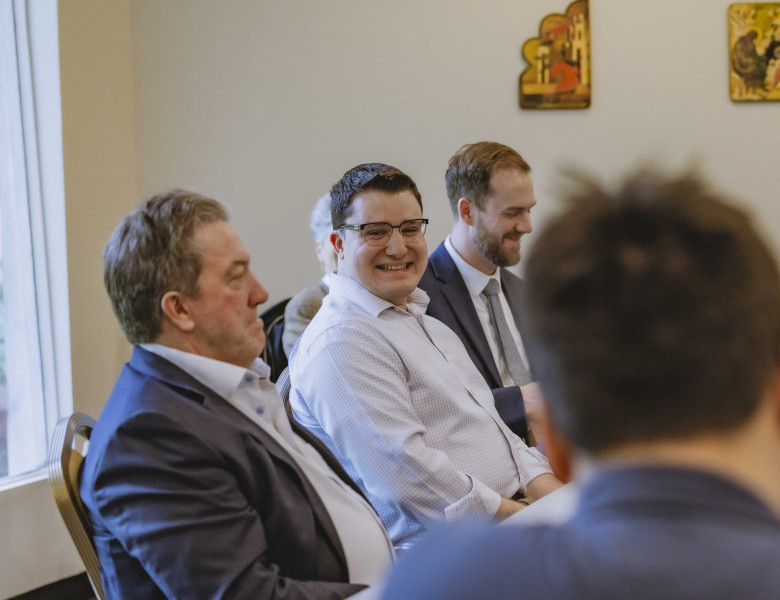
Students in the Honors Program and members of the Philosophy Club at the University of St. Thomas recently gathered for a discussion on how philosophical training, particularly majoring in philosophy, can shape one’s life and career, featuring alumni Sean Tracey ’88 and Andrew Troxler ’20.
The presentation in the Honors Seminar Room, hosted by professors Dr. Michael Boler, Honors Program Director and associate professor of Classics, and Dr. Martin Lockerd, associate professor of English and director of the William J. Flynn Center for Irish Studies, brought students together to hear how the study of philosophy continues to influence UST alumni in their professional ethics and personal formation.
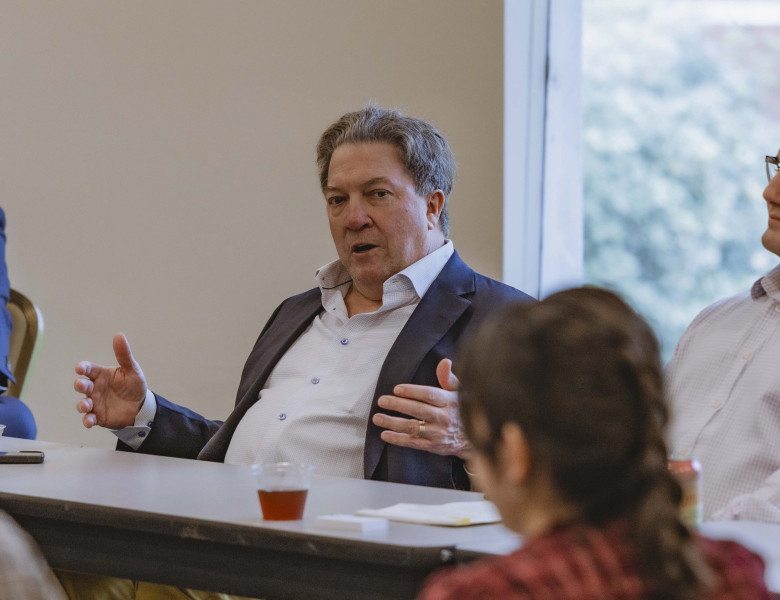 Tracey, a board-certified civil trial and personal injury attorney and managing partner at Tracey Fox & Walters, and Advisory Board Member for the Center for Irish Studies, reflected on the philosophical foundation he received at St. Thomas.
“I saw the lawyer as the vessel to help re-balance the world,” he said.
Tracey said his studies introduced him to ideas that have guided both his career and his personal life.
“I learned that if you want to live a good life, you can train yourself; there are such things as virtues. If I paid attention to the culture, I would actually go wrong,” he said.
He explained that philosophical thought and concepts were very practical tools once he entered law school and the courtroom. His abstract ideas about justice, truth claims and proving something to be true or false really grounded him.
“How do I prove something is good or bad,” he asked. “That’s what lawyers do within the paradigm of the justice system. We have rules of evidence. We use the same causation arguments that Aristotle put forth in 350 BC. The law uses those. The same precepts that Aristotle taught in terms of persuasion or advocacy, pathos and logos that I learned here, are what lawyers use, some of them without knowing it.”
 Tracey said the Catholic and philosophical tradition he encountered at St. Thomas continues to influence his work.
“Truthfully, because I'm a lawyer and in the business of pursuing truth claims for a living, and for people, I have never strayed far from philosophy,” he said. “I continue to read philosophy. I continue to go back to Aristotle. I continue to go back to the Summa. I continue to look at Augustine and ‘The Confessions.’ Some of the greatest arguments I've ever read I've stolen from the ancient philosophers. Sometimes I even give them credit when I'm in trial, but it always confuses people when I start talking about Thomas Aquinas in the middle of a closing argument.”
But this is what Tracey lives for—articulating his philosophical knowledge, grounded in his Catholic faith, to advocate for the good of the other. For Tracey, philosophy provided a framework for evaluating truth and making consequential decisions, which is essential in the courtroom.
“I am able to objectively evaluate the true from the false because of the training I received in philosophy at UST,” he said. “It is really something I could never have gotten anywhere else. It's a great gift.”
Tracey too encountered people who questioned his study of philosophy as he was becoming a lawyer—joking that he would not be able to “philosophize the bar.” However, Tracey sees things differently.
"The best law students were philosophy majors,” he said.
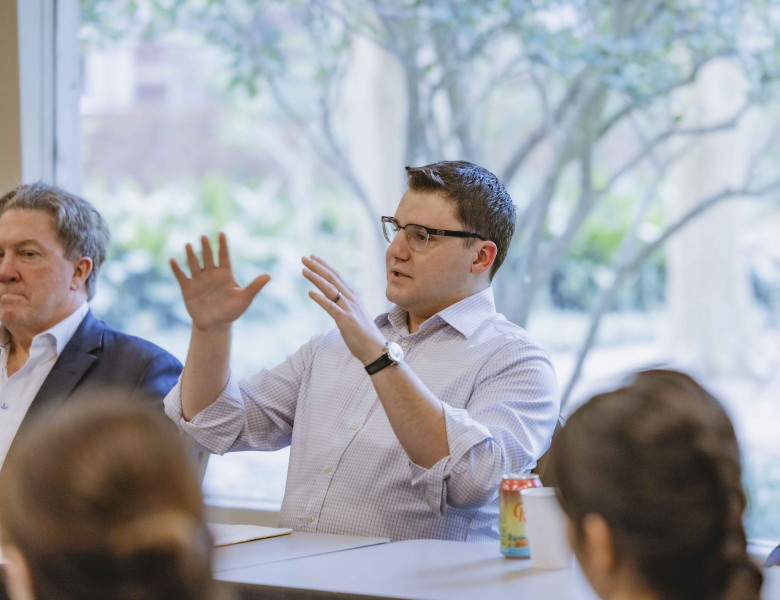 Following Tracey’s talk, Andrew Troxler, an Honors Program alumnus who now works as a Senior Natural Gas Trader at Calpine, echoed that sentiment while describing his own academic journey.
He began as a political science major before finding his path to philosophy. Troxler graduated summa cum laude with a Bachelor of Arts degree in Philosophy and minors in Finance, Accounting, Economics and Classical Languages. He said the intellectual habits developed through philosophy and the Honors Program continue to shape his career.
“I can't stress enough the usefulness of the ability to think abstractly that I learned both from the Honors Program and literary analysis and philosophy itself,” he said. “Attacking the things that underpin our ideas at their root and root level of first principles is something that's been helpful.”
Troxler said students who study liberal arts now have the edge in a changing workforce that is placing value on critical thinking.
“People who imply that your options as a philosophy major were to be a delivery driver or teach were definitely quite pervasive,” he said. “But it's really starting to turn the corner, and companies aren't necessarily looking for cookie cutter people for cookie cutter roles anymore.”
As artificial intelligence and automation reshape industries, Troxler said employers increasingly need workers who can think critically and evaluate complex situations.
“There’s a lot of processes that can be very easily automated,” he said. “And the question employers are left with is, ‘What kind of a worker do we need?’ More and more, it's coming down to somebody who can think critically and evaluate a situation rapidly and for multiple facets at the same time.”
He also encouraged students to continue to develop the ability to reason inductively and apply ideas to new circumstances.
“The ability to use inductive reasoning and abstract thought is critical,” he said. “When you're presented with a similar circumstance that has similar reasons at play, you can start to make logical connections that surprise people. That’s because of a philosophical grounding to uncover truth,” Troxler said.
He continued to celebrate abstract thinking as a differentiator in the job market.
“I think that ability to think abstractly and inductively, to take information and generalize it to a universal idea and understand when that idea is applicable and able to be remanifested, is something that's really unique to liberal arts majors as a whole.”
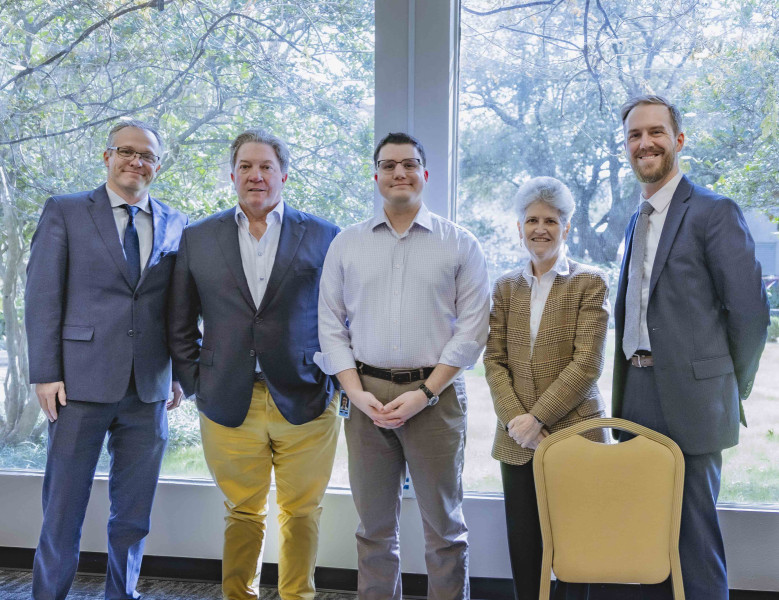 Both alumni speakers also addressed how their philosophical formation shaped their understanding of happiness and human flourishing. Tracey said philosophical training helped him recognize the difference between apparent happiness and genuine freedom.
“There are things that I'm going to encounter in life that appear to be symbols of freedom and happiness, that are actually slavery and misery,” he said. “The discipline of thinking that I learned here—that there are virtues that are real and objective, and there are vices that are real and objective—that's super important and essential to my life as a Catholic every day.”
He continued by imparting how evil in the world is a real problem.
“You know, the seven deadly sins are real,” he said. “I learned that virtue and vice are real. Virtue is its own reward; vice is its own punishment. Making good decisions, having the ability to discern the true from the false, the good from the evil, and those ambiguities that live in between those two polarities is what matters.”
Troxler offered a similar reflection.
“Happiness is ultimately acting virtuously,” he said.
Both alumni emphasized that the University’s philosophical tradition—rooted in Aristotelian and Thomistic thought and grounded in the reality of the physical world—continues to shape how they approach their work and lives.
For students in attendance, the conversation illuminated to them how philosophical study can influence varied and diverse professions. The grounding of pursuing truth and seeking the good not only equip someone for a good life, but it also allows virtue to flourish in any career path.
So, regarding the initial question—Can students really do anything besides teaching if they have a philosophy degree? After hearing from Tracey and Troxler, the answer is an unmistakable yes.