
When the Master of Fine Arts in Creative Writing program was launched five years ago, Founder Dr. James Matthew Wilson had high hopes.
"We hoped our writers would eventually form the center of a new literary generation, one with a renewed and wide vision and a reformed and deepened standard of literary craft,” he said. “All that happened much, much sooner than expected.”
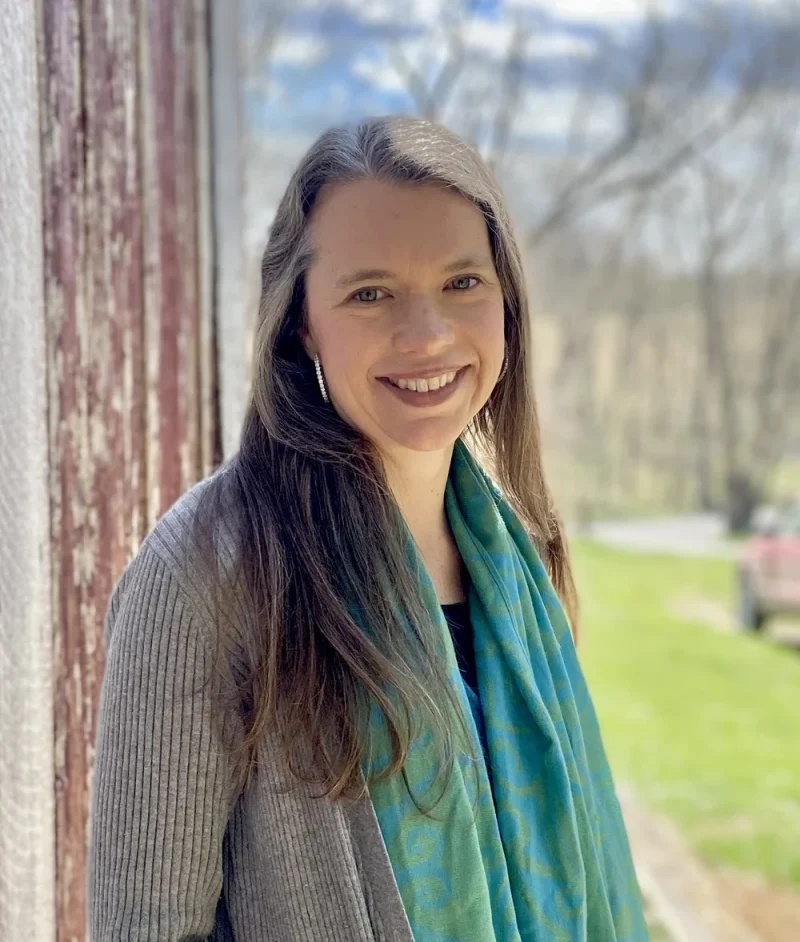
Now, with a bevy of writers publishing their work with popular literary magazines, journals, and presses, Wilson continues to celebrate the vast and increasing accomplishments of his students. Recently, The Trustees of the Robert Frost Farm in Derry, N.H., announced the winner of the 17th Annual Frost Farm Prize for metrical poetry was MFA in Creative Writing Graduate Carla Galdo, MFA ’25, for her poem “The Absences Are Different.”
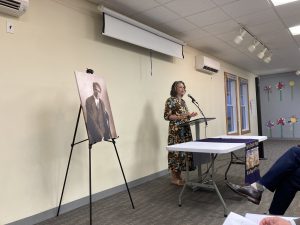
The winner, among other prizes, received an invitation to read at the Hyla Brook Reading Series, at the Robert Frost Farm in Derry, New Hampshire, which Galdo did in August 2026. The reading opened the three-day Frost Farm Poetry Conference.
“I have to say I am incredibly humbled to have done this reading at Frost Farm, given the audience, which was made up of not only fantastic poets, but also many poets that have been my teachers, mentors, friends or 'inspirations' over the years,” she said. “I like to approach a reading as a rhetorical event—as something that has a beginning, middle and end, that flows with intentionally placed moments of seriousness and levity, or complexity and simplicity.”
According to the Frost Farm website, the 2026 Frost Farm Prize judge, Ryan Wilson, selected the winning poem after reading more than 600 anonymous entries. He had this to say about Galdo’s winning poem:
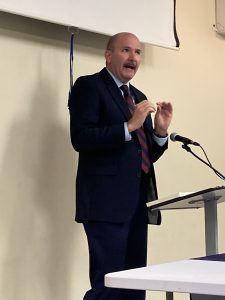
“’The Absences are Different’ is a poem, paradoxically, about presences, specifically the presence of ‘such fleeting things’ as hummingbirds, empty cups, tides, and memories. Comprised of six sentences—three indicative, two imperative, and a final indicative—the poem is not at all the straightforward piece of advice that such an arrangement might suggest. Rather, it is alive with verticality and verges on the Baroque with its elegant sestets—arranged 3A 5B 4A 3C 4B 5C—through which a fluent syntax cascades in such a way as to recall Donne, Herbert, and, perhaps more fully, Thomas Traherne, and yet the poem never feels archaic, or ‘old-timey,’ but remains tenaciously grounded in our present.”
UST boasts another Frost Farm award winner in 2024—MFA in Creative Writing Graduate Sarah (Spivey) Ashbach, MFA ’26, for her poem, “The Dispossession,” out of 876 anonymous entries.
“Winning the prize in 2024 was a shock,” Ashbach said. “That January, I had just begun sending out poetry submissions in earnest, so more than anything else, I’d submitted to Frost Farm to prove to myself that I wasn’t a coward. It certainly helped to bolster my confidence going forward. Before, it had seemed unlikely that anyone would read my poems with much interest. After, I began to take myself much more seriously as a writer.”
Wilson said UST writers have quickly established themselves as among the most talented at work today.
“Editors and publishers know what to expect when they hear a manuscript is coming from a St. Thomas author,” he said. “Despite all this sudden and satisfying achievement, who could have expected that two of our poets would win the Robert Frost prize in a three-year span? If you read the poems themselves, however, you will not be surprised. Sarah and Carla have both given us excellent poems, brilliantly chiseled and exploratory of that sacred word, ‘enchantment.’"
Galdo said when she applied to the MFA program, her interest in writing poetry was secondary. She was mainly hoping for a Catholic, Master’s-level degree that would give her a deeper understanding of the English-language literary tradition.
“I was blown away by how much I enjoyed writing poetry, especially formal poetry, once I started to get the hang of it,” she said. “The first class I took—Dr. James Matthew Wilson’s The Craft of Poetry—was a crash-course introduction to the world of metrical verse. In that class, my appreciation of formal poetry skyrocketed, and as I wrote sonnets, villanelles, and even a brave-but-probably-not-too-great sestina, all in my halting beginner-iambics, and read many examples of these forms as well, I finally started to love and appreciate the long tradition of formal verse.”
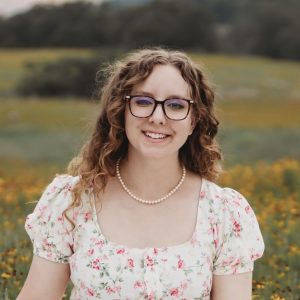
Ashbach agreed that the MFA program was rigorous, but she said the professors “toughened me up” and “made me a much better writer.”
“Our workshops and seminars are always brimming over with profound experiences and insight,” Ashbach said. “That’s because the vision of the program is oriented around truth, goodness and beauty as meaningful ways to know God, transformative encounters with texts, and a deep dedication to writing as an artistic craft. That’s probably the single most important ‘lesson’—to take your craft seriously. Not many programs do. Ours is dedicated to a sort of anti-Gnosticism: the material of your craft, the medium of your art, is meaningful, and its meaning is not incidental. All art is revelatory. Our role as artists is a reflection, through a glass darkly, of God as Creator. His creation reveals himself; similarly, even in its darkest moments, art reveals beauty, drawing the soul toward him who is Beautiful.”
Galdo encourages students who may be interested in creative writing, or even poetry, to give it a try.
“To anyone who feels intimidated by either reading or writing formal verse, I would say— don’t be! If I can learn to write formal poetry as a middle-aged mom, you certainly can too,” she said. “A poem might capture a moment that is a half-step forward toward hope, or a moment of floundering, or even a half-step backward into despair— and that’s enough material for one good poem, if the moment is evocatively, creatively explored.”
She mentions that the UST MFA was integral to her formation as a poet.
“The full-time faculty at the UST MFA, as well as the UST MFA Summer Residency guest faculty, have been immensely important in my formation,” Galdo said. “Not only did they guide me in my craft as I began to learn it, but they inspired me with their own writing—everyone on the Creative Writing faculty is a published author, and it has been fascinating and informative to simultaneously learn from them as teachers while enjoying their outside work—whether it be poetry, novels, or criticism—on my own time.”
For more about the UST MFA in Creative Writing, visit stthom.edu/mfa.