
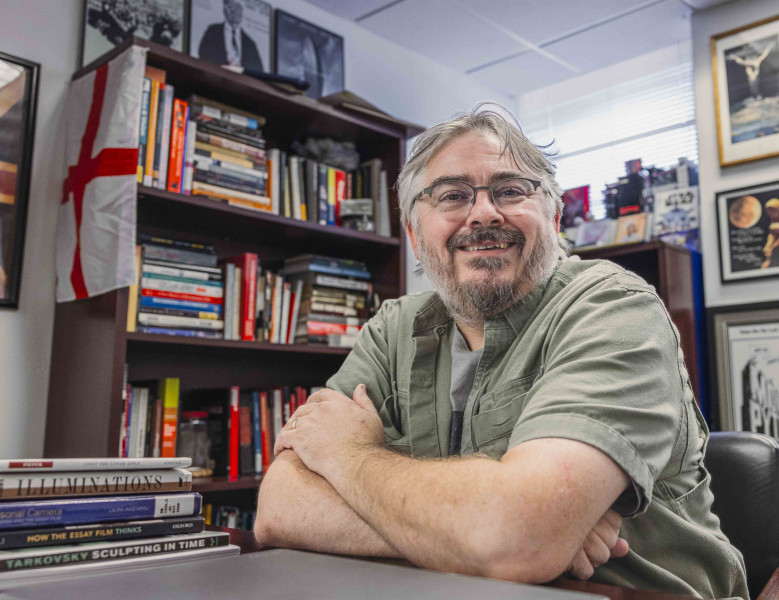
Long before he became Chair of the Department of Communication and Performing Arts at the University of St. Thomas, Marek Ryszard Dojs was a student wandering the UST campus, captivated by ideas that combined his love of history and his desire to tell a great story.
A history lecture would remind him of a theology discussion; a communication course would connect to something he remembered in literature. The disciplines seemed to speak to one another and Dojs was all ears.
“I loved history because I encountered truth, beauty and goodness there,” he said. “Once I started seeing those things in history, I began noticing them everywhere else too. You can find them in science, literature, theology, really in any field of study. When you encounter something true, good or beautiful, there is a natural desire to share that encounter with others.”
The experience taught him to see connections, particularly how history informed communication, faith informed storytelling, and how truth could be pursued through multiple disciplines.
Born in London, Dojs immigrated to the United States with his family and grew up in the Sugar Land area of Texas. The son of an English mother and a father who was a child of Polish refugees who fled Europe after World War II, he describes himself as “a British Pole, raised in America.”
“I was the first of my family to go through the American schooling system,” he said.
When he arrived at St. Thomas in the fall of 1994, he quickly embraced the University’s liberal arts tradition. He earned a joint degree in history and communication, along with minors in English and theology, immersing himself in nearly every subject that sparked his curiosity.
“The liberal arts was in the air,” he said. “It was just something that was breathed in by everybody.”
As a student, Dojs loved history but also spent countless hours in the basement of Doherty Library working on video projects, which started off as a hobby from high school when he taught himself video editing using two VCRs. At the beginning of his senior year at UST, a friend from the history department handed him a poster for a short graduate program in historical documentary filmmaking at George Washington University. Something clicked.
“For all this talk about integration of knowledge, it never occurred to me that I could combine my majors like that,” he said. “History and communication could come together so seamlessly.”
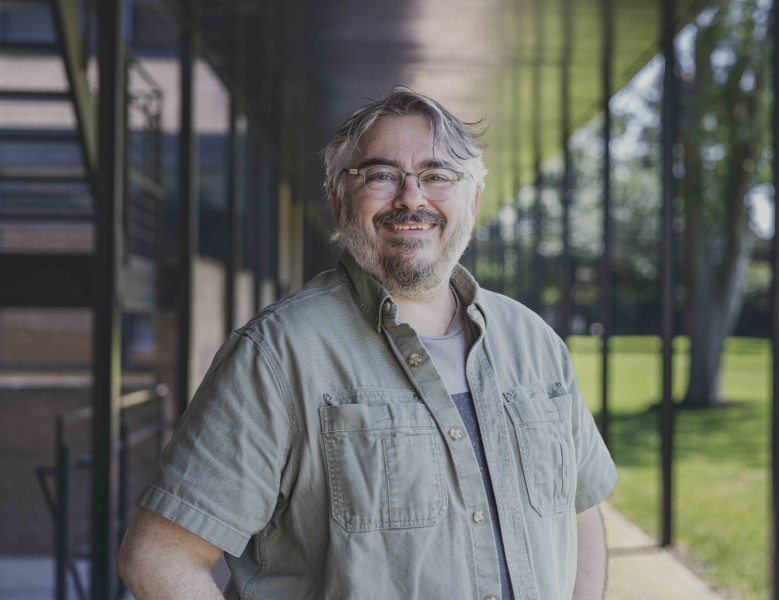 At George Washington, Dojs helped create a documentary examining politics, race relations, and historical memory framed through the infamous Peekskill Massacre in New York in 1949. The experience taught him a lesson that would stay with him throughout his career: storytelling is never a solo act.
“People don’t understand the work that goes into making a film,” he said. “When people see our work, it’s a flyer, or it’s a story written, it’s a photograph. In my case, it’s a 20-minute film. So much of media requires intense work, keen specialization and collaboration, cooperation and clear communication,” he said.
After completing the program, Dojs returned to Houston, where his future wife, Madeline, was finishing her studies at St. Thomas. He briefly worked in local media before accepting what was supposed to be a six-month interim position in youth ministry at his parish, St. Theresa's Catholic Church in Sugar Land. It lasted six years.
The role deepened his passion for mentoring young people and sharpened his understanding of communication as something more profound than information sharing.
“I loved mentoring the youth, and I used a lot of media,” he said. “It’s all about the presentation of the message that is really important in communicating a story.”
He created videos, presentations and creative projects to connect with students and communicate larger truths.
Eventually, another calling emerged.
After reading Pope John Paul II’s apostolic letter “The Rapid Development,” Dojs felt compelled to dedicate himself more fully to media and storytelling.
“The message said basically that if you have the charism of using the media, you should do everything you can to be proclaiming the message of Christ,” he recalled. “So, I was really convicted to focus more on media.”
In 2006, with two toddlers and a newborn, he and Madeline made a leap of faith. They moved to Denton, Texas, so he could pursue a Master of Fine Arts degree in documentary filmmaking at the University of North Texas. The decision transformed his understanding of storytelling.
Dojs entered the program intending to make traditional historical documentaries. But one project, “Frogs and Snails,” changed the direction of his work. Created while he was anticipating the birth of his second son, the intensely personal film reflected on his own journey from boyhood to manhood and forced him to grapple with questions that could not be answered through historical research alone.
The project also challenged him in a practical way. Translating deeply personal and abstract ideas into a film required him to communicate his vision clearly to an entire creative team.
“That film forced me to learn how to communicate more abstract ideas to different people,” he said. “I had these deeper questions that I wanted to investigate, so I needed to work well on a collaborative team.”
The experience transformed his understanding of documentary filmmaking. Rather than viewing film primarily as a vehicle for expression, Dojs began to see it as a form of inquiry—a way of exploring questions that resist easy answers.
“I use my camera like a scientist uses a microscope,” he said. “I'm pointing my camera at things to study and research to get the answers to particular questions.”
His work increasingly turned inward, drawing on his family’s history.
One of his most significant films, “Return to Stołowicze,” traced the story of his grandmother, who was deported by Soviet forces to Siberia as a child during World War II. Decades later, Dojs traveled to her village in present-day Belarus, reflecting on the tragedies that shaped his family’s existence.
“I’ve always struggled with knowing that my existence is predicated on the fact that my grandmother had to suffer tremendously,” he said. “I wish it never happened, but then my father wouldn't be here. I wouldn't be here. How does one reconcile that? So, it's always a struggle. It's a poetic piece reflecting on the horror that had occurred that's a part of one’s history.”
The film became both a historical exploration and a deeply personal meditation on memory, suffering and identity.
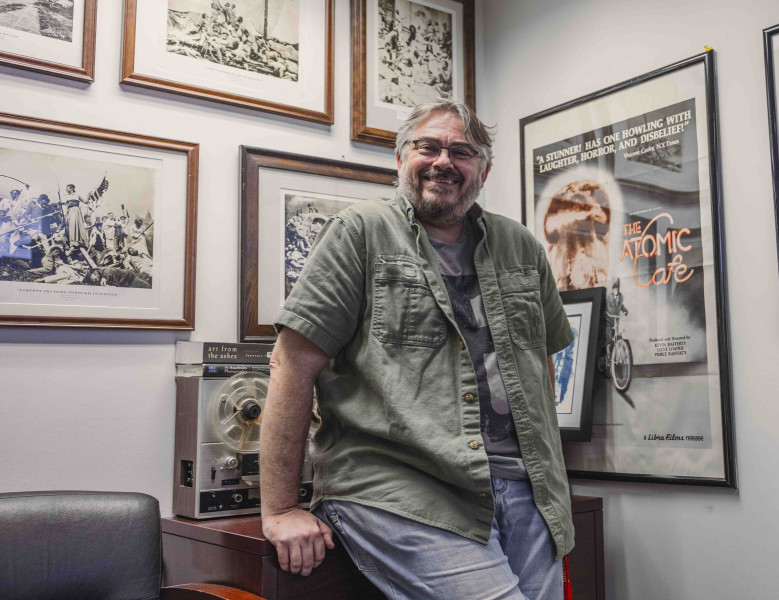 Years later, while pursuing a doctorate in Holocaust and Genocide Studies, that family history resurfaced in an extraordinary way. While researching Holocaust photography, Dojs discovered what he believes is a photograph of his grandfather inside Auschwitz-Birkenau.
His grandfather had been a member of the Polish underground resistance before being captured and imprisoned by the Nazis. The discovery became the foundation of another film, completed in just five weeks, “The Vanishing Point.”
“It felt very much like everything that I was touching when I was doing that film just worked,” he said. “It is a story of exploration and one that honors the memory of the victims of the Holocaust. It was a story that needed to be told.”
The project also reinforced questions that have defined much of his scholarship and creative work: How do stories survive after eyewitnesses are gone? How do we preserve memory? How do we communicate truth to future generations? Those same questions now shape his work with students.
After teaching at Southern Arkansas University and spending 11 years at the University of Mary in North Dakota, where he helped build film and media programs while raising a family that eventually grew to nine children, Dojs began feeling called back to Houston.
In 2023, after friends encouraged him to consider a position at St. Thomas, he and his wife discerned the possibility and things fell into place.
“If God is calling us to Houston, then He’ll make it known,” he said. “And He did. It’s an honor to be able to come back and to be chosen to lead the program that I was once a part of.”
Since arriving, much of his work has focused on rebuilding relationships with students and reimagining a communication curriculum rooted in the University’s Catholic mission.
For Dojs, communication is fundamentally about human connection.
“The root word of communication and community; they’re the same thing,” he said. “There’s something about communication that is more than just sharing a message. It’s the sharing of a message that then builds unity and community.”
That belief aligns closely with the University of St. Thomas mission to pursue truth, foster human dignity and educate the whole person.
In an era overflowing with information, Dojs wants students to understand that communication is ultimately about something deeper.
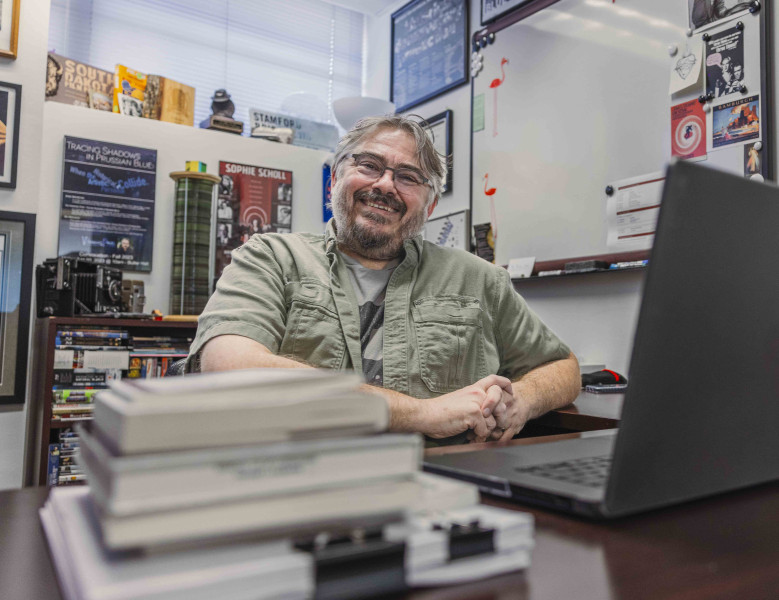 “There’s a lot of communication going on in our world,” he said. “There’s lots of information being shared, but none of it’s bringing together relationship, and relationship is a central thing for us. When good communication is created, there's something transformative about the message that's being shared. And the presentation of the message is key.”
Whether through film, journalism, public relations or digital media, he challenges students to ask the same question he asks young filmmakers.
“What’s your story really about?” he probes. “Students should really be reflecting on this question as they create just about anything. We’ve got to approach storytelling in this way to bring the world to something deeper.”
From a student exploring the intersections of history, faith and communication, to a filmmaker uncovering stories buried by war, to an educator mentoring the next generation of storytellers, Dojs has spent decades searching for ways to communicate truth. Now, standing once again on the campus where that search began, he finds himself exactly where he is meant to be.
"Every program, every department, plays an integral role in a larger story,” Dojs said. “My own story reflects that. The University wouldn’t be the same without each of them. I’m grateful to come back, build on the foundations that have been laid and help lead it into the future.”