
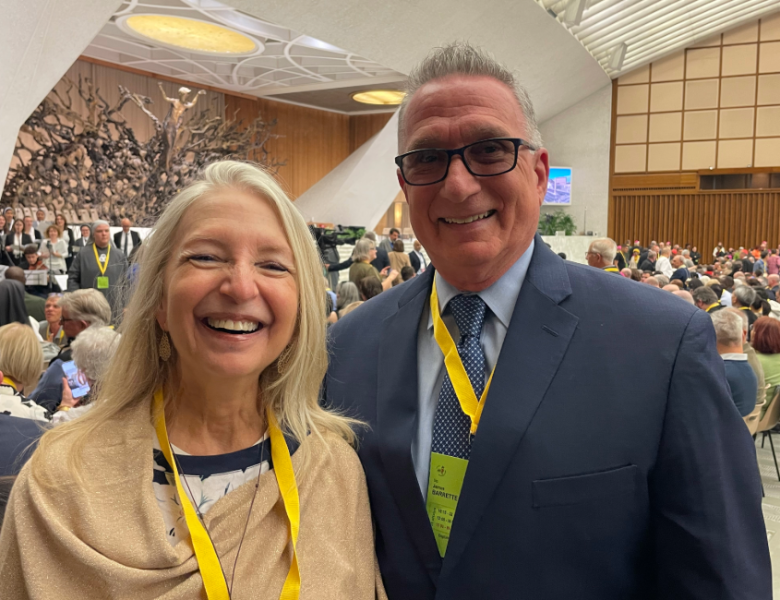
The Catholic Church desires to be a place that honors listening, discerning and walking with others. Dr. C. Elizabeth (Beth) Barrette, Ed.D., M.B.A., director of Consortia Relations and Adjunct Professor in the School of Education and Human Services, attended the experience of a lifetime to explore just how the Church can make that desire a lived reality.
The Jubilee of Synodal Teams and Participatory Bodies was a global gathering of the leaders in the Catholic Church at the Vatican from Oct. 24–26, 2025. Rooted in the spirit of the hope of Jubilee, the event affirmed the vital role of synodal teams and participatory bodies in shaping a Church that is ever more attentive, collaborative and faithful to its mission.
Dr. Barrette, a part of a team of three people from the Archdiocese of Galveston-Houston, was one of approximately 2,000 members of presbyteral councils, pastoral councils, finance councils and other synodal bodies from dioceses, eparchies and national and regional groupings from around the world. This was the first collective step in the implementation phase of the orientations that emerged from the Final Document of the XVI Ordinary General Assembly of the Synod of Bishops, translating discernment into concrete pastoral and structural choices.
Dr. Barrette sat down with Senior Director of Communications Bridget Richardson to share her experience of attending this monumental event.
Bridget Richardson: Can you describe the Jubilee of Synodal Teams and Participatory Bodies in basic terms?
Dr. Beth Barrette: The Jubilee of Synodal Teams and Participatory Bodies brought together about 2,000 people from around the world who serve on synodal teams or in participatory bodies like pastoral, finance and presbyteral councils. At its heart, it was meant to honor those who help their dioceses “walk together,” and to encourage us as we continue to build a more synodal Church. For me, it felt like both a celebration and a commissioning. The Jubilee blended formation, dialogue, and prayer, including workshops, small-group discussions, and beautiful liturgies. It was also an opportunity to reflect on how we can put the orientations of the global Synod into real pastoral and structural choices. The highlight for many was Pope Leo XIV’s closing Mass on Sunday, which beautifully grounded everything in hope and mission. In simple terms, it was a global “thank you” for the work already done and a strong “let’s take the next steps together” for the Church’s future.
 BR: What was it like being a part of the Archdiocesan team? Who else were you on the team with?
BB: The Archdiocesan team that attended this Jubilee event was representative of the larger Archdiocesan synodal teams. The diocesan phase of the Synod on Synodality invited every diocese around the world to engage in broad listening and dialogue. Initiated by Pope Francis I, this phase embodied his call for a Church that listens, accompanies and journeys together which was a central theme of his pontificate. Parishes, ministries, schools, religious communities and lay groups gathered to reflect on how the Church is called to grow in communion, participation and mission. Each diocese synthesized what it heard into a report. These national syntheses formed the foundation for the next stage, the continental phase, and this (no exaggeration!) marked a historic moment of listening to the voice of the worldwide Church community. It was a great honor and deeply meaningful to be a part of it.
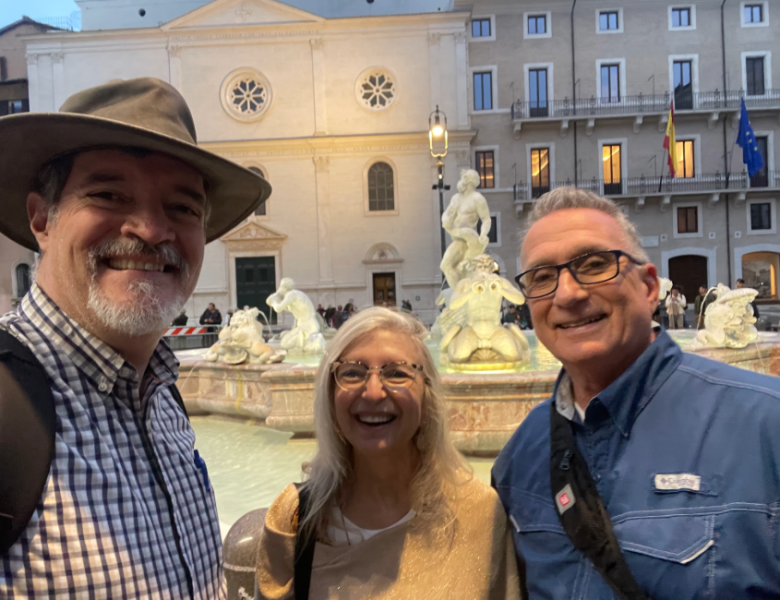
At the invitation of Archbishop Joe S. Vásquez, I was part of a team led by my husband, Jim Barrette, who serves as Secretariat Director of Pastoral and Educational Ministries [for the Archdiocese]. The other team member was Mr. Ricardo Medina, Director of the Office of Family Life [for the Archdiocese]. The three of us brought very different roles and perspectives, yet we were united by our shared love for our Archdiocese and our hope for the Church’s synodal mission. Traveling and participating together gave us the chance to discuss what we were seeing, hearing and learning in real time. It also helped me appreciate how broad and interconnected the work of synodality really is and how it touches families, parishes, schools, formation programs, diocesan leadership and our University, too! I felt so grateful to share this journey with this team; being part of it made the experience more collaborative, reflective and hopeful.
 BR: Were there any standout speeches or homilies?
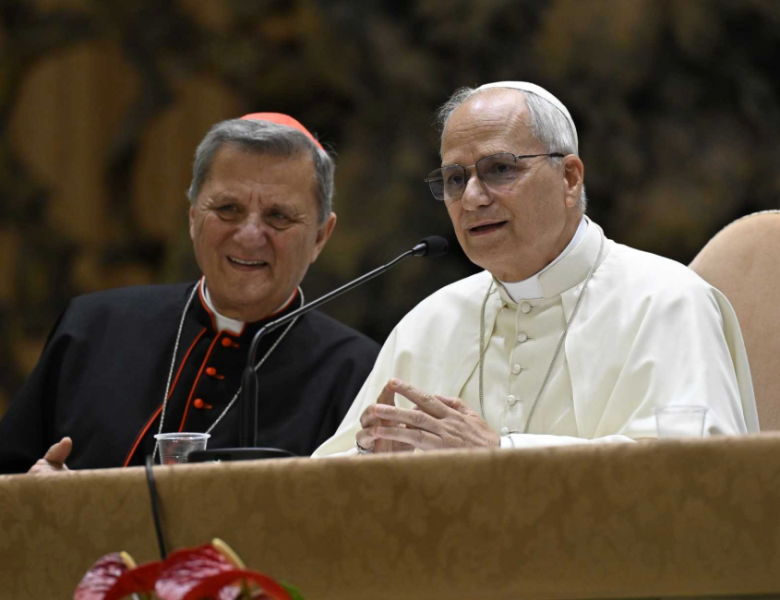
BB: Absolutely. The most moving for me were Pope Leo’s responses to questions posed by representatives from each continent. He spoke with authenticity, warmth and genuine pastoral love ... and impressively, he did so in three languages, engaging each question with care and depth. I also found Cardinal Grzegorz Ryś’s address especially compelling. His reflections on the key tensions within the Church — “I” versus “we,” unity versus uniformity, and preservation versus mission — were both honest and hopeful. He invited all of us to what he called a “relational conversion,” reminding us that evangelization is “faith working through love,” not simply the accumulation of personal knowledge. I appreciated how he blended wisdom, wit and sincerity, making his message both accessible and profound. His talk continues to resonate with me as I think about how we walk together as Church ... and how we walk together as a University community as well.
BR: Did you get to meet with Pope Leo? What stood out to you in the American dialogue?
BB: While none of our group met with Pope Leo personally (that I know of), I truly felt as though I did. As he addressed our gathering of about 2,000 people, he had that wonderful and rare pastoral gift of making you feel as if he were speaking directly to you. During the American dialogue, what struck me most was his attentiveness. He listened deeply, took notes and responded thoughtfully to the concerns raised by each of the seven continental regions represented (Africa, Oceania, North America, Latin America and the Caribbean, Europe, Asia, and the Middle East). The conversation centered on how to accompany all communities who may still feel hesitant about synodality. Pope Leo emphasized patience, openness of heart and the need to dispel fear through genuine encounter. I found his approach both grounding and encouraging. Even from across the room, he created a sense of closeness and connection that stayed with me.
 BR: What do you hope to bring back to the Archdiocese and UST with you?
BB: What I most hope to bring back is a renewed commitment to fostering communion, participation and mission, i.e., the three pillars of synodality. This Jubilee reaffirmed for me that synodality isn’t just a process or a meeting; it’s a way of life and ministry. The Church describes it as the modus vivendi et operandi of God’s people: a way of journeying together that shapes everything we do. I want to carry this spirit into both the Archdiocese of Galveston-Houston and my work at the University of St. Thomas. That means encouraging structures of listening (which includes creating space for alternative viewpoints and "agreeing to disagree"), shared discernment, and co-responsibility, and creating spaces where people feel genuinely heard and valued. It also means cultivating hope: “planting dreams, drawing forth prophecies and visions,” as the Synod beautifully says. Ultimately, I deeply hope our communities can experience synodality as a source of renewed mission, unity, and joy.
BR: What else would you like to add about this important participation?
BB: This experience reminded me how naturally synodality fits with the mission and culture of the University of St. Thomas. In our commitment to dialogue, collaboration, critical thinking, moral leadership, and the integration of faith and reason, we already live many synodal principles every day. Meeting participants from different dioceses, countries and ministry settings helped me see how synodality works in countless contexts – how "wherever two or more are gathered" we can give love and hope to their communities. The workshops I attended, especially those on interreligious dialogue and on men and women working together for a synodal Church, expanded my understanding of how broad and inclusive this mission truly is. I returned home feeling inspired, grateful and more convinced than ever that synodality is not only possible but transformative. It offers us a way of being Church that is more collaborative, more compassionate and more deeply rooted in the Gospel.