

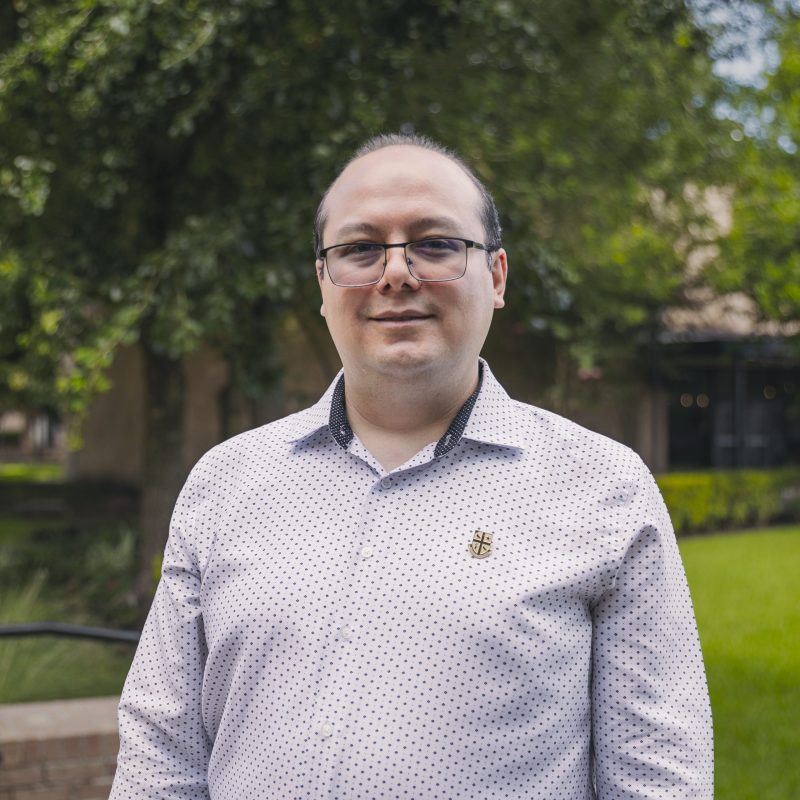
Chemistry professor publishes research in prestigious journals
The newest faculty member in the University of St. Thomas Department of Chemistry and Biochemistry, Dr. Christian Sandoval-Pauker, recently published two research manuscripts and one editorial article in highly respected chemistry journals.
Most notably, one of his research papers was published in the Journal of the American Chemical Society (JACS), which is widely regarded as one of the most prestigious and influential journals in the chemical sciences. The research paper is titled, “Metallaphosphinidene Coupling with a Phosphorus Ylide to Form a Phosphavinyl [P═CH2]− Ligand.”
Dr. Richa Chandra, chair of the UST Department of Chemistry and Biochemistry, is elated at this accomplishment.
“JACS is widely regarded as one of the most prestigious and influential journals in the chemical sciences,” she said. “Publication in JACS is a significant achievement and reflects research of exceptional scholarly impact and international visibility.”
In addition to the JACS publication, Dr. Sandoval recently published a manuscript in Advanced Functional Materials, a leading journal in materials science. It was titled, “Pyrene-Based Covalent Organic Frameworks With Diacetylene Linkers for Tandem Adsorption and Photodegradation of Perfluorooctanoic Acid.”
Dr. Sandoval-Pauker said these publications advance the field of chemistry in distinct ways.
“The study on per- and polyfluoroalkyl substances (PFAS) (Advanced Functional Materiasls) provides insights that can support the design of more effective materials for environmental remediation,” he said. “The phosphorus chemistry study (JACS) expands our understanding of unusual bonding and reactive pathways that are difficult to characterize through experiments alone.”
Dr. Sandoval-Pauker also co-authored an editorial in ACS Central Science titled, “Reconsidering Excellence in the Chemical Sciences: Lessons from First-Generation Chemists.” He said this third manuscript contributes to the broader scientific community by challenging traditional definitions of excellence and emphasizing the importance of mentorship, resilience and community impact in shaping the future of chemistry.
“These publications highlight the different areas of my research, including computational chemistry, environmental science, and fundamental chemistry,” Dr. Sandoval-Pauker said. “The two research manuscripts combine computational simulations and collaborator experiments to address challenging chemical problems, including PFAS removal and unusual phosphorus chemistry. The editorial in ACS Central Science examines how the scientific community defines excellence, emphasizing the need to recognize not only research productivity but also resilience, mentorship, and broader community impact.”
Dr. Sandoval-Pauker joined UST in August 2026 following two years at Rice University as a J. Evans Attwell Welch Postdoctoral Fellow. His research integrates computational chemistry, catalysis, and materials science, using density functional theory (DFT) and machine-learning approaches to develop sustainable solutions for environmental remediation and chemical synthesis.
“I think this work shows that at UST, teaching and research can go hand in hand,” Dr. Sandoval-Pauker said. “It shows our students we can connect what we learn in the classroom with real scientific problems and broader collaborations. It also fits well with the spirit of Ex Corde Ecclesiae, especially the idea that knowledge should be pursued with purpose and used in service of others.”
Dr. Sandoval-Pauker tries his best to integrate his skills in the classroom.
“I use molecular models, visualizations, and computational tools to help students understand concepts that can be difficult to see on paper, such as molecular geometry, conformations, stereochemistry, and reactivity,” he said. “These approaches let students visualize molecules in three dimensions and connect abstract concepts to the actual behavior of chemical systems.”
He said research on environmental problems, fundamental chemistry and mentorship allow us to connect the field with questions that have a real impact on society.
“Good research requires rigor, curiosity and critical thinking,” he said. “I want students to ask not only what the result is, but how we know it is reliable. My goal is to help students see research as something they can actively participate in and contribute to at UST.”
He also has two additional publications with dual Rice University and University of St. Thomas affiliation, which is currently under review.
For more information about the UST Department of Chemistry and Biochemistry, visit the website.